
How to Choose a Watch Winder Manufacturer: A Buyer’s Guide for Brands and Retailers
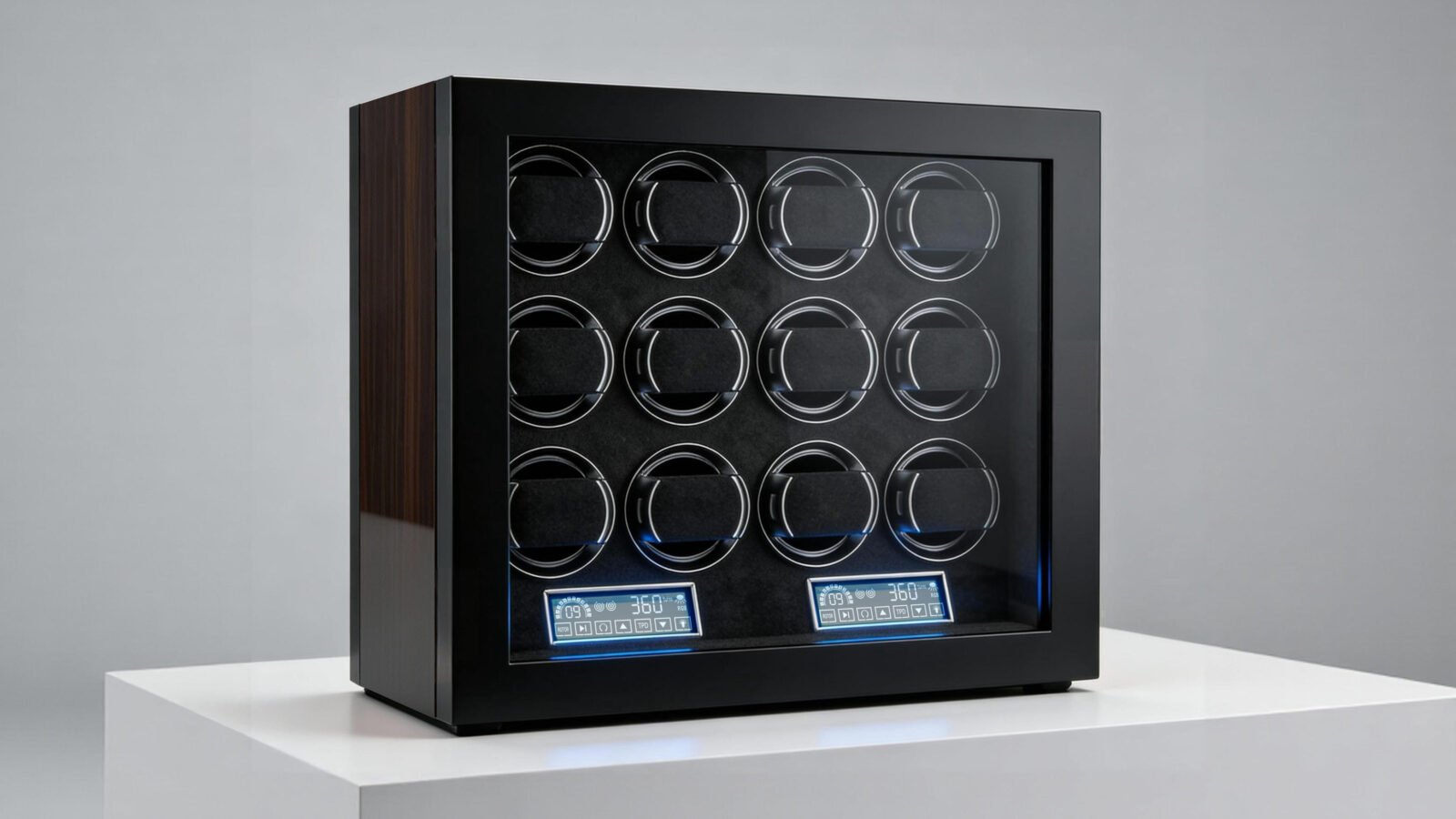
Sourcing a watch winder is a different exercise from sourcing most other packaging. A watch box only has to look good and protect its contents; a winder also has to run, silently, for years, without the motor timing drifting or the bearing wearing loose. That’s the part a product photo or a single sample can’t tell you. Below is what we’d actually check, based on running this category since 2008.
Start with the motor, not the finish
Piano lacquer and leather are what a customer sees first, but the motor is what determines whether the unit still works in year three. Ask a supplier directly about motor type, expected duty cycle, and whether rotation direction and turns-per-day (TPD) are configurable per slot or fixed at the factory. A winder built for continuous, silent operation should be able to answer this without hesitation — if the answer is vague, that’s usually a sign the factory is assembling from a generic motor module rather than engineering the electronics in-house alongside the case.
Ask what’s actually made in-house
Many “manufacturers” in this category are really assemblers — wood casework from one subcontractor, motors from another, leather interiors from a third. That’s not necessarily disqualifying, but it does mean quality control has to happen across multiple handoffs instead of one production line, and it usually shows up as inconsistency between production batches. A factory that handles woodworking, lacquer finishing, leatherwork and motor assembly under one roof can hold a tighter tolerance because the same team is accountable for fit, finish and function together.
Check the compliance paperwork before you check the price
If you’re importing into the EU or US, CE, RoHS and UL certification (as applicable to the electronics inside a winder) aren’t optional extras — they’re what gets your container through customs without a hold. Ask for documentation up front, not after the deposit is paid. A factory that’s been through EU-market compliance reviews repeatedly will have this ready in minutes; one that hasn’t will need weeks, which tells you something about how many export markets they’ve actually shipped into.
Look at how long their relationships actually last
Client testimonials are easy to write. Multi-year reorder history is not. One of our longest-running programs is with a major European electronics brand that has ordered piano-lacquer and leather winder cases from our factory continuously since 2008 — spanning a full 2- to 12-slot range, built to strict EU compliance standards, without a break in supply. That kind of tenure is a better signal than any single sample review, because it reflects consistency across dozens of production runs, not just one.
Match MOQ to where your brand actually is
A factory quoting the same MOQ for a single-slot winder and a 12-slot cabinet either hasn’t thought about their own tooling costs, or is quoting a flat number that doesn’t reflect actual production complexity. In our own catalog, MOQs range from roughly 20 units on large cabinet pieces to 100–200 units on smaller single winders and accessories — ask for that kind of tiered breakdown rather than one number, so you can plan a launch quantity that actually fits your sell-through.
If you’re scoping a winder program right now, what’s the biggest unknown standing between you and a first sample order?