
Watch Box and Watch Stand RFQ Checklist for B2B Buyers
Why Joint Watch Box and Watch Stand Inquiries Require Split Engineering Schedules
Watch brands, retailers, and private-label programs frequently source presentation watch boxes alongside desktop watch stands from one factory. Coordinating both formats under one partner unifies wood veneers, piano lacquer coatings, and cushion colors across boutique displays and collector packaging. However, combining both categories into an undifferentiated Request for Quotation (RFQ) often distorts unit pricing and triggers sampling revisions.
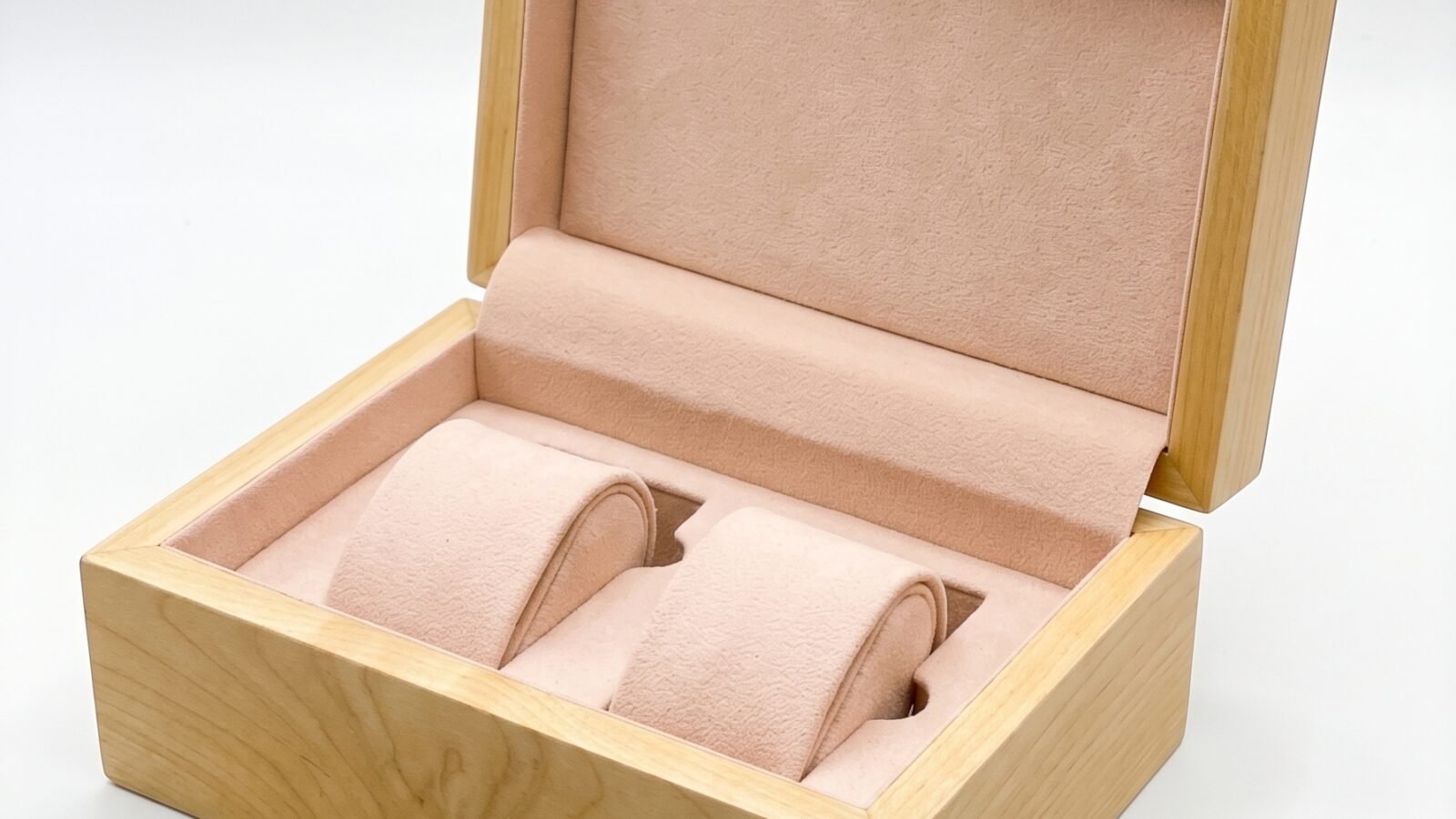
Although both products are non-electronic woodworking items sharing panel cutting and spray-booth lines, their engineering and cost drivers differ. A wooden watch box is a hinged enclosure governed by mitered joinery, lid alignment, internal partitions, and quadrant hinges. Conversely, a watch stand is an open fixture governed by base ballast, metal rod machining, mechanical screw fixings, and T-bar pillow balance. Bundling them without defining independent SKU packing forces suppliers to pad cost buffers.
To secure transparent, apples-to-apples factory quotations, procurement teams should first review the manufacturer’s verified watch boxes and watch stands capabilities, then split the RFQ package into separate cabinet joinery, stand hardware, and export carton schedules.
Separate Enclosed Cabinet Joinery from Cantilevered Stand Hardware
An effective multi-category RFQ isolates enclosed box construction from open stand hardware so woodworking and metalworking engineers can calculate Bill of Materials (BOM) costs accurately. Buyers should structure their inquiry package around two distinct technical specification sheets.
For wooden watch boxes, the quotation sheet must define enclosure geometry, multi-coat surface finishing, and interior compartment architecture:
Capacity and footprint: Specify slot count and exterior dimensions—such as 2-slot solid wood boxes, 6-slot lacquered boxes (320 x 220 x 150 mm, 2 rows of 3), 10-slot rubberwood boxes (295 x 215 x 80 mm), 12-slot veneer cases (WB-3054, 365 x 220 x 90 mm), or 16-slot double-layer piano lacquer boxes (275 x 240 x 162 mm, 8 watches per layer). Lid and hardware: Specify solid or glass-window lids, quadrant hinges, and front lock plates (with or without key). Grid and pillows: Define divider thickness and removable cushion sizes—such as 55 x 70 x 75 mm leather-sleeved or velvet pillows—fitting men’s and women’s wrist sizes.
For wooden watch stands, focus on base stability, metal pillar anchoring, and bolster firmness. Using the WS-1001 through WS-1007 series as benchmarks, define base plate sizes (such as square 100 x 100 mm, 120 x 120 mm, or 150 x 150 x 20 mm plates, circular 120 x 20 mm plates, or rectangular 170 x 100 x 20 mm and 210 x 150 x 20 mm bases), galvanized steel rods, underside screw fixings, and silicone PU leather cushions.
| RFQ Specification Area | Wooden Watch Box Schedule | Wood & Metal Watch Stand Schedule |
|---|---|---|
| Structural Architecture | Hinged MDF or solid wood cabinet with partitioned interior grid | 20 mm solid wood or MDF base plate with galvanized steel pillar |
| Watch Support Geometry | Compressible removable pillow (e.g., 55 x 70 x 75 mm) seated in slot | Elevated T-bar or cylindrical cushion (e.g., 75 x 60 x 20 mm) on metal bracket |
| Dimensional Envelope | Enclosed L x W x H (e.g., 320 x 220 x 150 mm for 6-slot box) | Base plate footprint plus total height (110 mm to 167 mm across WS series) |
| Surface & Tray Details | Multi-layer piano lacquer, matte wood veneer, or PU leather wrap | Lacquered or veneered base with optional CNC-milled recessed valet tray |
| Standard MOQ Baseline | 100 pcs (double-layer 16-slot) to 200 pcs (standard 6-slot/10-slot boxes) | 200 pcs per stand model (100 pcs acceptable with unit price adjustment) |
| Master Carton Packing | 4 pcs per master carton (2 x 2 layout, ~0.071 m3, 1.5–1.8 kg/unit) | 20 pcs per master carton with custom-cut EPE polyfoam and brown inner box |
Separating these six engineering parameters in the RFQ spreadsheet ensures that suppliers price each product line on its actual material and assembly inputs.
Reconcile Watch Cushion Compression, Case Clearance, and Stand Center of Gravity
Although both products support wristwatches, the mechanical forces acting on the cushion differ between an enclosed compartment and an elevated open stand. Copy-pasting pillow specifications between the two RFQ sheets is a primary cause of pre-production sample rejection.
Inside a watch box, the pillow sits enclosed by partition walls beneath a hinged lid. The cushion must compress smoothly across varied strap lengths while keeping watch crystals below the divider top edge. Specify slot center-to-center spacing and lid clearance so 42 mm to 44 mm bezels never rub against the upper lining.
On a watch stand, timepieces hang in open air on a bolster where gravity creates tipping leverage against the base. Whether specifying single-watch stands like WS-1002 (70 x 60 x 30 mm cushion, 129–147 mm height), WS-1003 (76.5 x 36 mm, 167 mm height), or WS-1006 (67 x 23 mm, 145 mm height), or dual-watch stands like WS-1001 (75 x 67 x 23 mm, 110 mm height), WS-1004 (75 x 60 x 20 mm, 132–135 mm height), and WS-1005 (118 x 67 x 23.5 mm, 150–151 mm height), confirm fit for watches up to 42 mm case diameter and one-sided load balance.
Coordinate Shared Wood Veneer Lots, Lacquer Batches, and Substrate-Specific Logo Zones
When a brand orders watch boxes and display stands for coordinated counter presentation, visual continuity across cabinet panels and 20 mm base plates is essential. Because piano lacquer and wood veneers can shift in tone across batches, lock in three controls before tooling:
Shared veneer and lacquer lots: Require that watch boxes and stand base plates draw from the same veneer lot and polyurethane batch, inspected together under standard lighting. Coordinated tray and cushion fabrics: On stands with a CNC-recessed valet tray (such as WS-1004), specify whether the tray pad matches the box’s interior suede lining or the stand’s silicone PU cushion. Separate logo drawings: Provide distinct artwork tolerances for each SKU—such as under-lacquer foil stamping or lid silkscreening on watch boxes, and exact vector zones on watch stands (e.g., a 32.5 x 13 mm top base logo zone, valet tray debossing, or a 135 x 73 x 2.5 mm bottom metal plate).
Reviewing 3D CAD renderings (returned within 8 hours for custom requests) and physical swatches prevents logo scaling errors.
Align Tiered MOQs, Sampling Schedules, and Export Carton Calculations
Finally, a complete RFQ must align order brackets, sampling timelines, and export carton rules so buyers compare landed costs accurately:
Tiered MOQs: Double-layer piano lacquer boxes start at 100 pcs per model, while standard 6-slot/10-slot boxes and wooden watch stands (WS-1001 to WS-1007) have a 200-piece MOQ (with a 100-piece tier available on stands at adjusted pricing). Request price breaks at 100, 200, and 500 pcs. Sampling and bulk lead times: Physical sampling takes 10 to 15 days (custom sample fee ~3x unit price, tooling extra, prepaid), and bulk production runs 20 to 45 days after sample approval. Payment follows T/T 30%–40% deposit, balance before shipment, with RoHS and REACH compliance stated on the PI. Export carton rules: Using the +40 mm inner box rule (`(L+40) x (W+40) x (H+40) mm`), a 6-slot box (320 x 220 x 150 mm, 1.5 kg gross) packs 4 pcs/ctn (720 x 520 x 190 mm, 0.071 m3). Conversely, watch stands pack 20 pcs/ctn in EPE polyfoam—such as WS-1002 (120 x 120 x 147 mm, 0.45 kg gross, 800 x 320 x 374 mm carton, 0.096 m3) and WS-1004 (150 x 150 x 135 mm, 0.65 kg gross, 950 x 380 x 350 mm carton, 0.126 m3).
Through the OEM/ODM customization workflow, locking in these structural, visual, and packaging specifications early keeps multi-item retail launches on schedule.
If your sourcing team is preparing an RFQ for custom wooden watch boxes and retail watch display stands, share your target model references, watch case sizes, and order quantities when you contact our team. Which detail is your top priority for your next collection: matching wood veneer and lacquer finishes across boxes and stands, verifying stand stability for 42 mm watches, or structuring flexible 100-to-200-piece MOQ tiers?