
Watch Winder and Watch Box Sourcing Checklist for Private Label Buyers
Why Source the Two Categories on One Brief?
A watch winder and a watch box can belong to the same private label accessory line, but they answer different customer needs. The winder is an active product with controls and watch holders. The box is a storage and presentation product whose layout and finish must be checked against the watches it is intended to hold. A buyer can coordinate their appearance without assuming that they share a structure, specification, or order quantity.
This watch winder and watch box sourcing checklist is designed for a brand team preparing a request for quotation or sample review. Its purpose is to make unanswered questions visible before artwork, photography, and packaging are approved. It does not describe a preconfigured bundle. If the products will be sold together, that commercial decision needs its own confirmation.
Write Separate Product Sheets Under One Collection Brief
Start with one collection-level brief: target customer, intended retail or gift channel, visual direction, and whether the items are independent listings or an approved set. Under that brief, keep a separate product sheet for each physical item. A finish that looks similar in a photograph may be applied to different underlying materials, so a shared color name cannot substitute for two approved specifications.
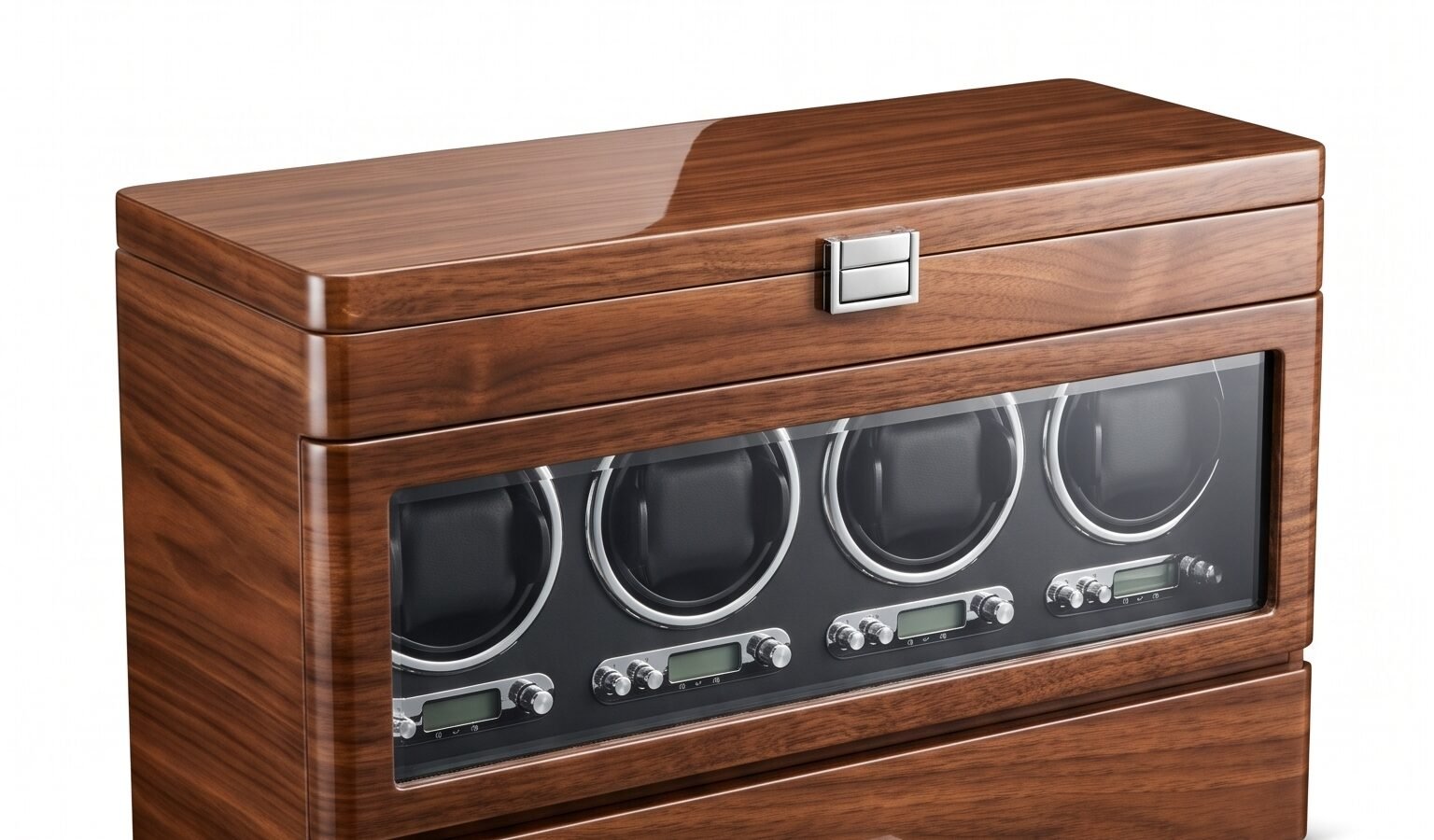
For watch winders, ask the supplier to identify the exact sample, the positions visible in it, the holder design, power arrangement, and available control configuration. Olymbros can support rotation-direction, turns-per-day, and timed-rest options, but those capabilities should only be assigned to a particular model after its specification is confirmed. The sheet should also record the cover or door material for the selected item. Do not infer glass from a transparent photograph; some shapes may use acrylic instead.
Confirm the Winder Sample Before Copywriting
A buyer should review a closed exterior image, an open interior image, and a clear control-area image for the same winder sample. The closed view establishes its form and finish. The open view helps the team check how watches are positioned and removed. The control view allows the approved product sheet to be compared with what a customer will actually see. If any image comes from a different sample, label it internally and keep it out of the final product listing until the difference is resolved.
Ask for a written list of included components as well as the unit itself. A photograph may show a watch, a cable, or a decorative item that is not part of the offer. The written list, packaging brief, and sample should agree before a listing claims what is supplied. Record proposed customization separately from the standard sample so that a possible future variation is not presented as an existing stocked configuration.
Give the Watch Box Its Own Construction Review
For watch boxes, the review begins with a complete closed view and an open view of the same item. Confirm the actual compartment arrangement and the way watches rest on the cushions. A close image can help with the lining and hardware review, but photographs alone do not establish material names or final dimensions. Those details belong on the approved product sheet.
The watch box and winder do not need identical construction to look coordinated. The buyer may choose related colors, surface finishes, or lining directions while still checking each item independently. Olymbros supports OEM, ODM, and private label development, with material options that include piano lacquer, matte wood veneer, leather, PU leather, and several lining directions. Which options are feasible for a particular sample must be confirmed during its own development process, rather than copied from a category-level capability list.
Use a Decision Table Before Requesting Samples
The following table is a checklist of questions, not a set of promised specifications. Complete the evidence column with the exact sample files and approved documents for the items under consideration.
| Decision to make | Winder evidence to request | Watch box evidence to request | Approval point |
|---|---|---|---|
| Identify the actual item | Sample reference and matching closed/open photos | Sample reference and matching closed/open photos | Confirm official model or keep a temporary internal ID |
| Confirm watch placement | Holder and interior views plus capacity specification | Compartment and cushion views plus capacity specification | Check that copy matches the approved sample |
| Define visible finish | Exterior and cover or door details with named materials | Exterior, lining, and hardware details with named materials | Approve each product's materials separately |
| Define order contents | Written components and packaging list | Written components and packaging list | State whether items ship separately or as an approved set |
| Approve customization | Marked artwork and model-specific options | Marked artwork and model-specific options | Sign off sample changes before final photography |
This table is particularly useful when a brand sends several references at once. It separates a decision about the look of the collection from decisions about the physical goods. It also gives the supplier a precise place to flag an unanswered question instead of silently filling a blank with an assumption from another model.
Decide Whether the Relationship Is Visual or Commercial
Two products can appear together in a campaign photograph without being sold as one SKU. For separate products, create two listings and explain their relationship through merchandising or cross-links. If the team wants a fixed set, confirm the components, approved finishes, packaging, quotation basis, and order identification before writing a bundle title. A shared photograph is evidence that two objects were photographed together, not evidence of a standard package.
This distinction matters in buyer-facing copy. A phrase such as “coordinated accessory line” can describe a design intention. A claim that a specific winder “comes with” a specific box describes the contents of a transaction and needs confirmation. Keep the two claims separate in the brief and in any later website or catalog page.
Compare Samples Against the Approved Brief
When samples arrive, compare each one with its own sheet before evaluating them as a pair. Check the surfaces and colors in ordinary light, the way each product opens, the fit and finish visible at contact points, and whether the provided packaging protects the actual item. Record observations with dated photos tied to the sample identifier. A revision should be linked to the original sample rather than filed as a new unnamed product.
Olymbros lists a sampling window of 7–14 days, but a buyer should confirm the timing for the requested configuration and current project before placing it in a launch calendar. A changed finish, lining, or control requirement can alter the work required for a particular approval. The review record should therefore state what was requested, what was received, and what remains open, rather than treating a category-level timeline as a guarantee for every variation.
Prepare Listing and Packaging Assets Only After Approval
Once the physical samples and their specifications are approved, prepare the public assets. Use a full exterior photograph for each product, then add the views needed to explain access, watch placement, and relevant details. Write alternative text from the selected real image, not from the original shot brief. Keep model-specific claims beside the image and specification that support them.
Before approving the final artwork, compare the product title, packaging copy, instruction material, and website listing against the same signed-off sheet. OEM/ODM customization can cover coordinated visual directions, but the public page should describe only the approved configuration. This final consistency check is less glamorous than a group photograph, yet it is where a private label line becomes clear enough for a buyer to quote, sample, and reorder.
If you are planning both categories, which winder and watch box samples should be reviewed together, and are they intended as separate listings or one confirmed set? Contact us with the two product references and the unanswered items from the table.